

Safeguarding data is among the most sensitive information a Multi-Academy Trust (MAT) handles. Incidents, behaviour logs, pastoral notes, vulnerability markers, and communication records must be protected with the highest level of care and available only to the right people at the right time.
But safeguarding data is also among the most vulnerable. Even the DfE thinks so, with new data sharing guidelines recently published by the ICO for safeguarding children. It’s important to clarify that data protection is not a barrier to safeguarding; it provides a clear framework to support this vulnerable data.
In many MATs, safeguarding tools, Management Information System (MIS) platforms, network filters, and identity systems all work independently. This lack of cohesion makes it harder to control access, monitor anomalies, or maintain compliance with GDPR and DfE standards.
The solution is unified security.
Why safeguarding data needs a unified approach
Safeguarding information sits at the heart of every Multi-Academy Trust’s responsibility to protect its pupils, yet it’s also one of the most vulnerable categories of data within a school environment.
When networks, identity systems, filtering tools, and reporting platforms operate in isolation, safeguarding data becomes fragmented, harder to oversee, and more susceptible to error or misuse.
It’s important that we see safeguarding data as more than just data - it's the pupils behind the data that need protecting.
Schools see the benefit of having school-wide shared values and rules that help ensure a consistent and high-level learning experience for all students. So just as consistency across schools in a Trust is key, so too is having a unified platform for security, bringing some of those same benefits. Effectively, all schools and students should be protected to the same high level, with all data accessible through a single pane of glass.
It’s important to note too that, as schools adopt more technology and Trusts grow, the strain on IT and Safeguarding teams increases. Consolidating the number of tools those teams need to manage can significantly reduce pressure.
1. Inconsistent firewalls = inconsistent protection
Many trusts still operate with a mix of local firewalls and ageing site-by-site filtering. When each school has its own perimeter, security policies vary. This creates blind spots and increases the risk of sensitive data leakage or misuse.
2. Fragmented logging makes investigations harder
When safeguarding incidents are logged across multiple systems, or when a school uses tools not used elsewhere, IT and safeguarding leads cannot see a clear trust-wide picture. Consistent logging and reporting, as emphasised in Fortinet’s visibility tools, is essential for rapid response and oversight.


3. Multiple identity systems weaken access control
Inconsistent identity management leads to:
Incorrect permission levels
Former staff retaining access
Students accessing materials they shouldn’t
Hybrid learning environments operating without strict access controls
Unified identity management, such as FortiAuthenticator SSO, closes these gaps when implemented as part of an improved IT strategy.
4. Cloud platforms increase exposure
Safeguarding information now moves between:
MIS systems
Digital behaviour platforms
DSL reporting tools
Cloud-based safeguarding systems
School-to-school transfers
Without a unified security model, each point of access introduces additional risk.
Unified security: the foundation of safer safeguarding
A unified security architecture creates trust-wide consistency that protects safeguarding data at every step.
As the adoption of technology in schools increases, the number of entry points for security breaches and the risk of students being exposed to harmful material also increase.
Whilst having a toolset that can protect your school is an absolute must, it cannot be done in a way that overencumbers IT and Safeguarding teams. This is why unified security platforms must be the foundation for safeguarding and security strategies within Trusts, ensuring a consistent security policy is implemented trust-wide while keeping management down.
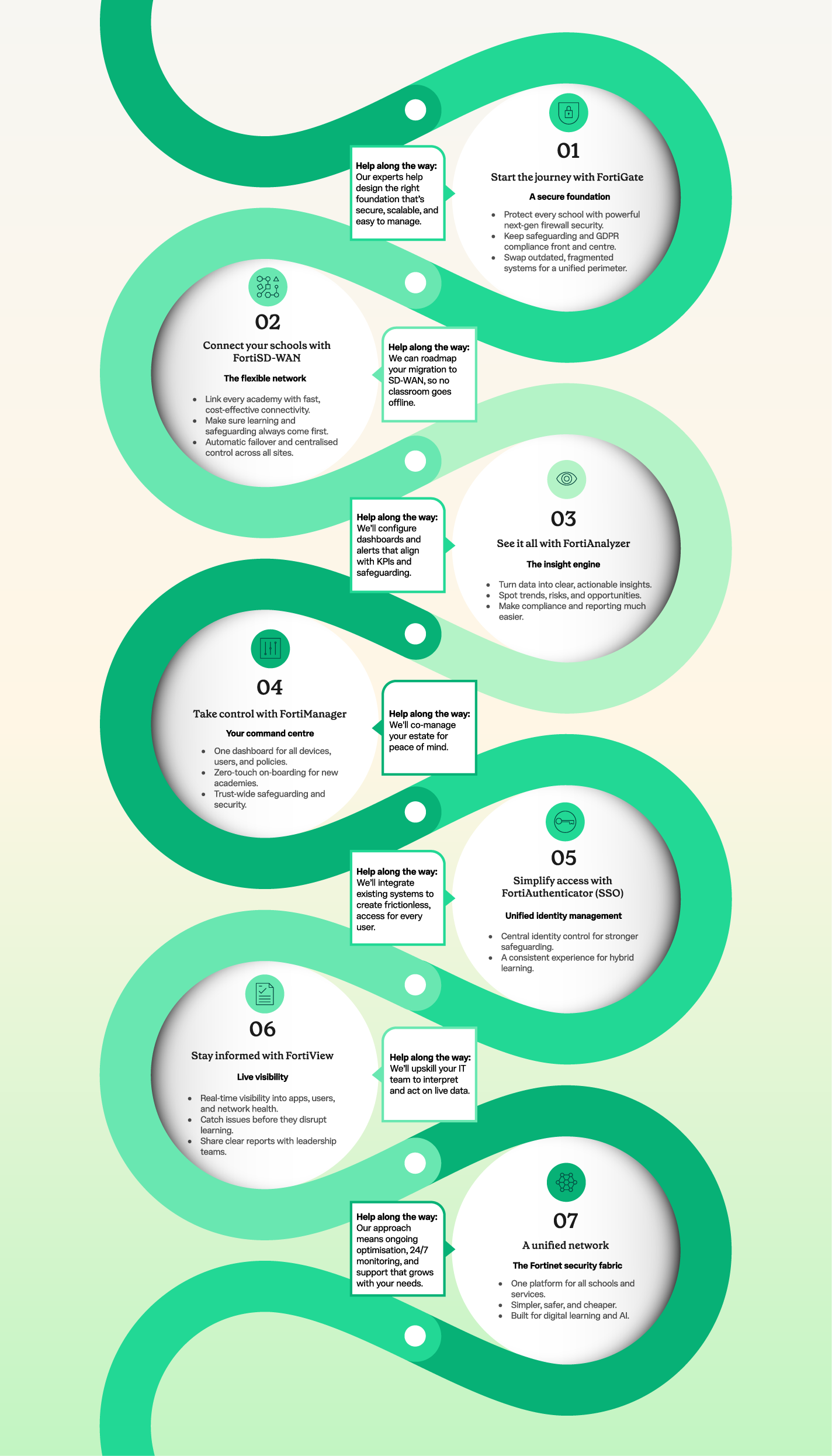
1. A single, secure perimeter for all academies
Using FortiGate firewalls across the trust, you’ll benefit from advanced threat protection, deep inspection, and consistent policy enforcement, keeping safeguarding and GDPR compliance front and centre.
2. SD-WAN for predictable and secure data flows
Safeguarding tools must work flawlessly. SD-WAN ensures that key applications receive priority, connections remain resilient, and sensitive data travels securely between sites.
3. Centralised monitoring with FortiAnalyzer and FortiView
These Fortinet tools give real-time visibility into network activity and security events, helping MAT leaders:
Detect anomalies early
Prevent unauthorised access
Simplify audits and evidence gathering
Provide clear reports to governors and senior leaders
4. Unified identity and access management
Centralising access through a single identity platform ensures consistent permission structures, smooth hybrid learning experiences, fast onboarding and offboarding, and stronger safeguarding controls.
5. Trust-wide standardisation
When every school runs from the same network foundation, updates, patches, filtering rules, and safeguarding policies are applied evenly. This eliminates the variation that exposes safeguarding data to risk, while also cutting some of the hidden costs associated with disparate IT systems.
How Nasstar helps MATs strengthen safeguarding through unified security
Nasstar combines education expertise with Fortinet technology to deliver secure, connected MATs, helping them to:
Unify firewalls, filtering, and security policies across all academies
Implement Zero Trust principles to verify every user, device, and connection
Deploy SD-WAN for stable safeguarding data flows
Centralise identity control for safer access management
Enable real-time visibility and alerting for safeguarding systems
Provide 24/7 monitoring and response
Support compliance with GDPR and DfE digital standards
Eliminate legacy systems that expose sensitive data
With Nasstar’s co-managed service, Multi Academy Trusts maintain control while gaining the resilience and expertise needed to protect the most sensitive data they hold.
A safer digital environment for every pupil
Unified security isn't just a technical improvement; it’s a safeguarding imperative. By consolidating networking and security, MATs gain the confidence that every school, every device, and every user is protected by the same robust framework.
Learn how Nasstar helps MATs secure safeguarding data through unified security
How’s your SASE readiness?
Get a practical view of your IT, security, and cloud maturity - built specifically for Multi-Academy Trusts.
Our Secure Access Service Edge (SASE) Readiness Assessment highlights your strengths and where to focus investment.
What you get:
An instant readiness score
A visual performance dashboard
Tailored recommendations aligned to your MAT's priorities
It only takes a few minutes to complete.